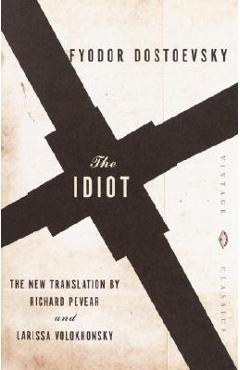
The Idiot - Fyodor Dostoevsky
In his second novel, Dostoevsky sought to portray a positively beautiful man, a saintly paragon in contrast to the murderer Raskolnikov of his first novel. Through Myshkin's struggle, in which his corruption seems fated, Dostoevsky offers a brilliant indictment of a society that cannot countenance virtue. Richard Pevear and Larissa Volokhonsky's masterful translation of The Idiot is destined to stand with their versions of Crime and Punishment, The Brothers Karamazov , and Demons as the definitive Dostoevsky in English. After his great portrayal of a guilty man in Crime and Punishment , Dostoevsky set out in The Idiot to portray a man of pure innocence. The twenty-six-year-old Prince Myshkin, following a stay of several years in a Swiss sanatorium, returns to Russia to collect an inheritance and be among people. Even before he reaches home he meets the dark Rogozhin, a rich merchant's son whose obsession with the beautiful Nastasya Filippovna eventually draws all three of them into a tragic denouement. In Petersburg the prince finds himself a stranger in a society obsessed with money, power, and manipulation. Scandal escalates to murder as Dostoevsky traces the surprising effect of this positively beautiful man on the people around him, leading to a final scene that is one of the most powerful in all of world literature.