Imagine furnizată de magazinul partener
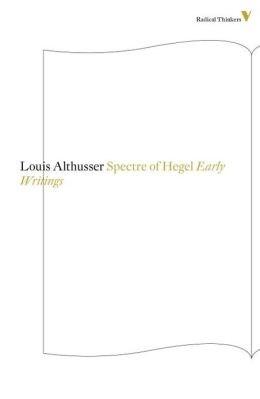
The Spectre of Hegel: Early Writings | Louis Althusser
Editură / brand: Verso Books
Preț în magazin
65,00 RON
COfertă de la carturesti.roPrețul final se confirmă în magazin
Vezi oferta în magazin↗Vei fi redirecționat către site-ul partenerului. Disponibilitatea nu este garantată de TârgulDeCărți.
✓
Preț actualizatdin feedul magazinului
↗
Cumpărare sigurădirect de la partener
Alertă gratuită
Te anunțăm când scade prețul
Lasă numărul de WhatsApp și primești un singur mesaj când produsul devine mai ieftin.
Descriere
Throughout the 1960s and 1970s, Louis Althusser enjoyed virtually unrivalled status as the foremost living Marxist philosopher. Today, he is remembered as the scourge and severest critic of 'humanist' or Hegelian Marxism, as the proponent of rigorously scientific socialism, and as the theorist who posited a sharp rupture - an epistemological break - between the early and the late Marx. This collection of texts from the period 1945-1953 turns these interpretations of Althusser on their heads: we discover that there was a 'young Althusser' as well as the 'mature Althusser' we are already familiar with. In his fascinating Master's thesis. 'On Content in the Thought of G. W. F. Hegel' (1947), Althusser developed a position which he was later to attack ferociously: namely, that the revolutionary potential of the Hegelian dialectic could be defended against Hegel's own political conservatism. We see Althusser still wrestling with the spectres of Hegel and of Catholicism in another long text, his letter to Jean Lacroix, and, finally, we see his own 'epistemological break' in the piece 'On Marxism' from 1953. Other texts included are his critique of Alexander Kojeve (whose interpretation Francis Fukuyama has recently revived) and his attack on the French Church's teachings on women, sex and the family. Widely recognized as an intellectual giant of the late twentieth century, Althusser has left a towering legacy. This collection not only gives a unique insight into the formation of such a personality, but will also restore the 'unknown Althusser' to the centre of the history of Marxism and of philosophy since the Second World War.